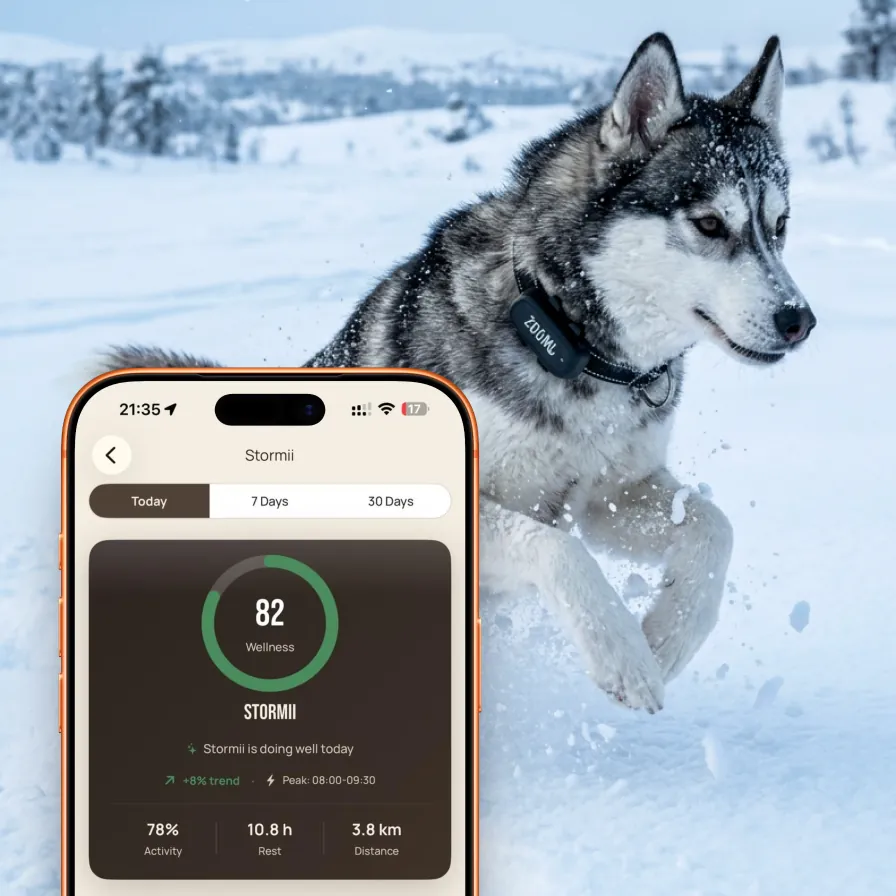

Your dog's collar tag is the single fastest way for a stranger to reunite them with you. Not a microchip — a microchip requires specialist scanning equipment. Not a GPS tracker — a tracker requires power and a data connection. A collar tag works the instant someone picks up your dog on the street.
Yet most dog owners have never thought critically about what their tag contains. Many have out-of-date phone numbers. Some list only a landline that nobody will answer at 11pm on a Wednesday. Others cram so many details onto a small disc that the engraving becomes illegible after a few months of wear. And every year in the UK, thousands of dogs go unrecovered not because they couldn't be found — but because the tag information was wrong, unreadable, or missing entirely.
This guide covers every detail: what UK law actually requires, what to include, what to leave off, the difference between engraved and smart QR tags, and how to make sure your dog's tag gives them the best chance of coming home.
What UK Law Requires
Under the Control of Dogs Order 1992, any dog in a public place in England, Wales, and Scotland must wear a collar with the owner's name and address inscribed on it or on a tag attached to it. This is not a recommendation — it is a legal requirement. Failure to comply can result in a fine of up to £5,000.
"Address" in this context means a postal address sufficient to contact you — your house number and postcode typically suffices. Your full street name, town, and county make the tag more useful and are advisable. Your name should be your surname, or full name — not just your dog's name, which satisfies neither the legal requirement nor a finder's need to contact you.
The Control of Dogs Order 1992 has been law for over three decades, yet surveys consistently show that a significant proportion of UK dogs are either untagged or wearing tags with incomplete information. Enforcement is rare, but the practical consequence — a dog that can't be identified — is far more costly than any fine.
Two important points owners frequently get wrong:
- Microchipping does not replace a tag. Dogs have been legally required to be microchipped since April 2016, and since June 2024 this extends to cats. But microchipping and tagging are separate requirements. A chip needs a scanner; a tag needs only a pair of eyes.
- Working dogs are not exempt by default. Some exemptions apply (police dogs, agricultural working dogs in some circumstances), but the vast majority of pet dogs have no legal exemption from the tagging requirement.
The Essential Information
Legal minimums aside, a well-designed dog tag contains everything a finder needs to contact you quickly and confidently. Here's what to include:
1. Your surname (or full name) and address
Required by law. Use your surname at minimum — your full name is better. For address, your house number and postcode is the legal minimum, but adding the street name makes it immediately useful to a finder who may not have a smartphone to look up the postcode.
2. Your mobile phone number — primary
This is arguably the most important single item on the tag. A mobile number means the finder can reach you immediately, wherever you are. Never rely solely on a home landline: if your dog escapes while you're at work, a landline is useless. If you only have space for one piece of contact information, make it your mobile number.
3. A second contact number
A backup contact — your partner, a family member, or a trusted friend — dramatically increases the chance of a timely reunion. If you're unreachable (phone dead, in a meeting, abroad), a second number means the finder has an alternative rather than giving up and taking your dog to a warden. This is especially important if you travel regularly.
4. A medical alert flag if relevant
If your dog requires medication, has a known allergy to common treatments (such as certain anaesthetics), or has a condition that a vet or warden would need to know immediately, a simple "Needs medication" or "Diabetic" engraving can be genuinely life-saving. You don't need detail on the tag — just a flag that prompts whoever has your dog to ask for more information.
5. "Microchipped" (optional but useful)
This signals to vets and wardens to scan the chip, connecting your dog to your full database record. It's not legally required but adds an additional layer of recovery redundancy for no extra space if your tag is large enough.
What NOT to Put on a Dog Tag
Just as important as what to include is what to leave off. Several common practices either waste space, reduce legibility, or create unintended security risks.
Don't put your dog's name on the front of the tag. This one surprises most owners: if your dog responds to their name, a stranger knowing it gives them a way to call your dog over or build false trust. This is particularly relevant in urban areas where dog theft is a real concern. If you want the name on the tag, engrave it on the reverse — visible to owners and vets, not immediately readable to someone watching your dog from a distance.
Don't list your full address in a way that signals you're away. A detailed home address on a dog that has clearly escaped during the day tells a prospective burglar that the house is likely unoccupied. A postcode and house number satisfies the law without broadcasting your movements.
Don't use a font so small it becomes illegible. Engraved tags have limited surface area. Trying to fit everything in will result in characters too small to read, especially as the tag wears. Prioritise contact number and postcode over secondary details.
Don't put a home landline as your only number. This is the most common and most costly mistake. A landline number on a tag assumes your dog escapes while you're at home, which is often not when escapes happen. Mobile numbers only, unless you list the landline as a secondary option.
Traditional Engraved Tags vs Smart QR Tags
For the vast majority of dog ownership history, an engraved metal disc was the only option. That has changed significantly. QR smart tags — which link to a digital pet profile when scanned — now offer a meaningfully better recovery tool, and understanding the difference helps you make the right choice.
| Feature | Engraved Tag | QR Smart Tag |
|---|---|---|
| Character limit | ~40–60 characters | Unlimited |
| Updateable without replacement | No | Yes — instantly from your phone |
| Vet details and medical info | No | Full detail |
| Multiple emergency contacts | 1–2 at most | Unlimited, labelled by relationship |
| Photo of the pet | No | Yes |
| Vaccine and medication records | No | Yes |
| Lost mode notification to owner | No | Yes — instant push notification |
| GPS last known location | No | Yes (ZoomiTag) |
| Works without internet (finder side) | Yes | Yes (name/number shown on scan) |
| Typical lifespan before re-engraving | 1–3 years (wear) | Permanent hardware; info always current |
| Satisfies UK legal requirement | Yes | Yes (name and address on/via scan) |
The practical argument for smart tags is not that they replace engraved tags — it's that they extend them. The QR code links to a profile that a finder with any modern smartphone can read within seconds, without needing an app, without downloading anything, and without you having had to anticipate every piece of information in advance.
What a Smart Tag Shows That an Engraved Tag Never Could
When someone scans a ZoomiTag, they see your pet's full digital profile — built and updated by you. This goes far beyond what's physically possible to engrave on a metal disc:
Vet details. Your vet's name, address, and phone number. If your dog is injured, the finder or a local vet can contact your practice directly — critical if your dog needs emergency treatment and you're temporarily unreachable.
Full medical history. Current medications (name, dosage, frequency), chronic conditions, allergies, and any known reactions to treatments. A dog with epilepsy, diabetes, or Addison's disease needs this information communicated immediately in an emergency.
Multiple labelled contacts. Not just "07xxx" but "Owner — James (mobile)" and "Emergency — Sarah (sister)". Finders can choose who to contact based on who is most likely to be available.
Real-time "I'm lost" alerts. If you activate lost mode in the Zoomi app, anyone who scans the tag gets a clear "This pet is lost — please contact the owner" notification with your contact details foregrounded. You receive a push notification the instant someone scans the tag, including their approximate location.
GPS last known location (ZoomiTag only). The map on the finder's screen shows where your pet was last tracked — narrowing the search area before the finder has even finished reading the profile.
Your Dog's Tag Should Work Harder Than an Engraving
ZoomiTag gives your pet a digital ID that anyone can scan — no app needed. Setup takes under two minutes, and the information stays current for life.
Get ZoomiTag — £44.99How to Keep Your Dog's Tag Information Current
The most dangerous tag is the one that was accurate two years ago. Phone numbers change. People move. Emergency contacts shift. An engraved tag capturing yesterday's details is worse than no tag in certain scenarios — it wastes a finder's time and delays reunion. Here's how to keep your dog's ID reliable:
- Update immediately on moving house. Your address is a legal requirement. Moving without updating your dog's tag — or the microchip database — is surprisingly common and leaves your dog unrecoverable to anyone relying on that information. Smart tag owners can update their address in the Zoomi app in under 30 seconds.
- Review your emergency contacts before any trip away. Before going on holiday or leaving your dog with a sitter, verify that all listed contacts are available and reachable for the duration. Add a sitter's number to your smart tag profile while you're away — remove it when you return.
- Update if your mobile number changes. Sounds obvious, but the same phone number can stay on a tag for years after it's been recycled, reassigned, or changed. Any phone contract change should trigger an immediate tag review.
- Set a six-monthly tag audit reminder. Add a recurring calendar event every April and October. Check that the engraving is still legible (look for worn characters), that phone numbers are current, and that the tag itself is still physically attached to the collar securely.
- Check QR code scannability. Physical damage — scratches across the QR code — can render a smart tag unscannable. Test yours with your phone camera every few months. ZoomiTag's QR codes are designed with error correction that tolerates up to 30% surface damage, but severe scratching can still cause read failures.
Collar and Tag Attachment
The tag is only as good as the collar keeping it in place. A few practical points:
Quick-release collars (also called safety collars or breakaway collars) are designed to release under pressure, preventing strangulation if the collar catches on a fence, branch, or other obstacle. They're particularly recommended for cats but are worth considering for dogs who spend time off-lead in wooded or rough terrain.
Tag attachment matters. Split rings (the standard key-ring style attachment) are the most common — and the most prone to working loose over time. S-hooks are more secure but require proper crimping. Welded rings or embedded screws offer the best retention. Check the attachment point monthly, particularly on dogs that swim or play rough.
Collar fit and wear. A collar worn on a dog that runs, swims, and rolls will show meaningful wear within 6–12 months. An illegible engraving on a scratched-up disc is worse than no tag because it gives the finder false confidence that they have contact information. Inspect the tag face regularly under good lighting — if characters are becoming hard to read, replace it.
A Note on Cat Tags
Everything above applies equally to cats. Since June 2024, all cats in England must be microchipped, but there is no equivalent to the Control of Dogs Order requiring collar tags for cats. However, the practical case is identical: a collar tag is the fastest recovery route if your cat goes missing. An estimated 230,000 cats are killed on UK roads each year — a tag that reunites a finder with an injured cat's owner within minutes can be the difference between treatment and a worst-case outcome.
Cat collars must always be quick-release (breakaway) design. Cats climb and squeeze into spaces that dogs don't — a fixed collar can cause serious injury or strangulation. Any cat collar tag should use a lightweight attachment that doesn't add significant weight or noise (some cats become distressed by jangling tags).
Frequently Asked Questions
Yes. Under the Control of Dogs Order 1992, any dog in a public place must wear a collar bearing the owner's name and address. This requirement has been in force since 1992 and applies regardless of whether the dog is also microchipped. Failure to comply can result in a fine of up to £5,000, though enforcement action is rare. The practical consequence — an unidentifiable dog — is the more common cost.
It's optional from a legal standpoint, but practically useful — a finder can use your dog's name to calm them. The risk cited (that a thief knowing the dog's name can gain its trust more easily) is real but minor in most contexts. Many owners include the name, or engrave it on the reverse of the tag as secondary information. Your contact number and address take priority on space-limited engraved tags.
Yes. A microchip and a tag serve entirely different purposes. A microchip requires a scanner — which means it's only useful once your dog reaches a vet, rescue, or dog warden with the right equipment. A tag is readable by any member of the public within seconds. Both are legally required in the UK. Together they provide two independent, complementary recovery routes.
At least two if the tag has space: your primary mobile and a backup contact. A home landline as the only number is a common and serious mistake — if your dog escapes while you're out, the landline is useless. Prioritise your mobile, and add a secondary contact (partner, family member) who is reliably reachable and can respond quickly if you're unavailable.
Yes. QR tags are legal provided the owner's name and address are accessible — either engraved on the physical tag or immediately visible on scan, without requiring account creation or app download. ZoomiTag's finder page loads instantly in any browser and displays your details on the first screen a finder sees, satisfying the spirit and likely the letter of the Control of Dogs Order 1992.
Stainless steel offers the best balance of durability, legibility longevity, and cost. Titanium is lighter and equally durable but more expensive. Aluminium tags are lightweight and cheap but scratch easily — engravings can become illegible within 12–18 months of regular wear, particularly on active dogs. Brass looks premium but discolours. For the longest-lasting solution, stainless steel or a durable QR smart tag (where information is digital and always current) are the best options.