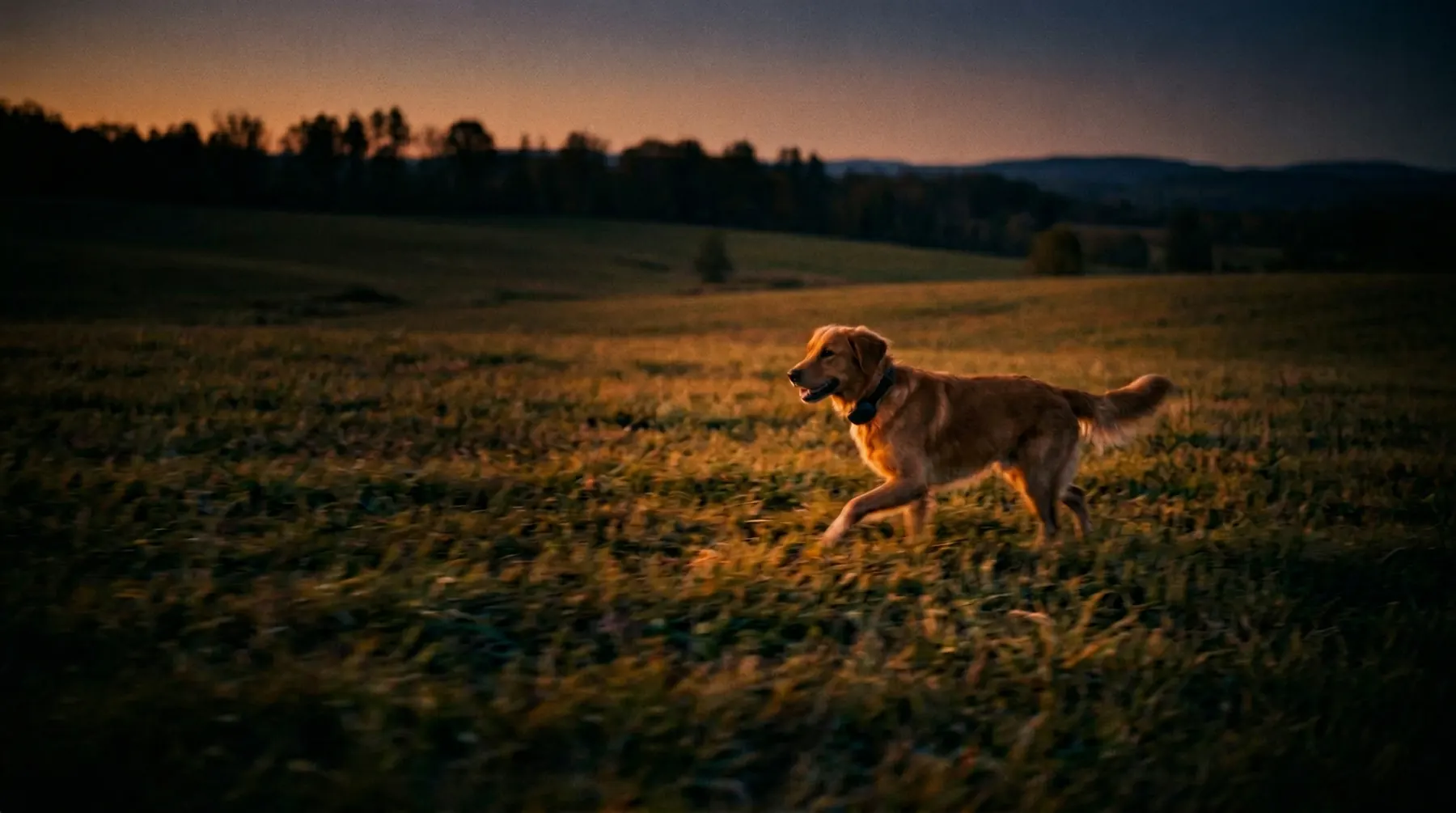
This Sunday — 25 October — the clocks go back, and the change lands on dog owners harder than on almost anyone. The walk that happened in golden hour on Friday happens in full darkness on Monday, and it will stay dark at walk-time until spring. No gradual adjustment, no easing in: one weekend, and every after-work walk for the next four months is a night walk.
The numbers say this deserves more preparation than it usually gets. Evening walks in darkness jump by more than a fifth in the week after the clocks change, and the winter months bring a rise of nearly a fifth in pedestrians killed or seriously injured on UK roads. Dogs sit inside both statistics — walked at the roadside, invisible in dark coats, startled by things neither of you saw coming. Here's the full setup: what actually changes, the kit that fixes visibility, the judgement calls, and the safety net for the moment it all goes wrong anyway.
What Actually Changes When the Light Goes
Four things, and they compound. Drivers lose you: a dark-coated dog on a grey pavement is close to invisible at 30mph in the rain, and the owner in a navy coat isn't much better; drivers pulling out of side roads are looking for headlights, not spaniels. You lose the ground: the glass, the dropped kebab, the bait box by the bins — the autumn hazards are all still there, now unseen. You lose the dog: even ten metres of darkness swallows a black Labrador whole, and recall against the pull of an invisible, fascinating night-scented world is genuinely weaker. And the season stacks its risks: the same fortnight that darkens the walks fills the sky with fireworks — the classic bolt scenario is a bang during a dark walk, and it peaks between now and mid-November.
Overnight, millions of UK walks move from dusk into true darkness — same route, same time by the clock, entirely different risk profile. The week either side of 25 October is when the winter kit needs to be ready, not on the shopping list.
The Visibility Stack: Be Seen From Every Angle
Visibility gear splits into two types that solve different halves of the problem, which is why the answer is both, not either:
- Active light on the dog — the non-negotiable. A small LED collar light or clip-on beacon is visible from every direction, all the time — to drivers, cyclists, and you when the recall works and forty kilos of dark dog is inbound. Clip it to the collar or harness top, check the battery weekly, and prefer a steady or slow-pulse mode; fast strobes can be hard to judge distance against.
- Reflective gear — the headlight moment. Reflective leads, harness strips and coat piping light up brilliantly, but only when headlights hit them — which is precisely the moment that matters most at the roadside. Cheap, passive, no batteries to die.
- You, lit too. The pair of you is a unit: reflective strips on your coat or a clip light on your body means the driver sees the whole picture, not a mystery light bobbing at ankle height. A head torch beats a phone torch — it points where you look and leaves both hands free for lead and poo bags.
Routes and the Lead: The Boring Rules That Do the Work
Three habits, all free. Choose lit, pavemented routes for the after-dark slot and save the field loop for daylight — the best dark route is often not your best daylight route. Short lead near traffic: the Highway Code (Rule 56) says dogs on a road or shared path should be on a short lead, and after dark that's not bureaucracy — an extending lead vanishes at night, and five metres of invisible cord between you and a kerbside dog is how the worst happens. Where there's no pavement, walk facing oncoming traffic, dog on your inside, away from the road — and honestly, after dark, reconsider whether that route can wait for the weekend.
The Off-Lead Question, Answered Honestly
Can you let a dog off in the dark? In a secure, enclosed, familiar space — yes, with a light on the collar. Everywhere else, the honest answer is that the odds have moved against you: recall degrades at night, the scent-world gets louder, you can't see what your dog has noticed until they're already committed, and a startle — a fox, a cyclist's light, a firework — sends them in a direction you can't track by eye. Through this particular fortnight, with displays starting, the case for the lead is at its strongest of the whole year. If last week's fireworks guide described your dog even slightly, the after-dark walk stays on-lead until mid-November, full stop.
Your Eyes Fail First. The Map Doesn't.
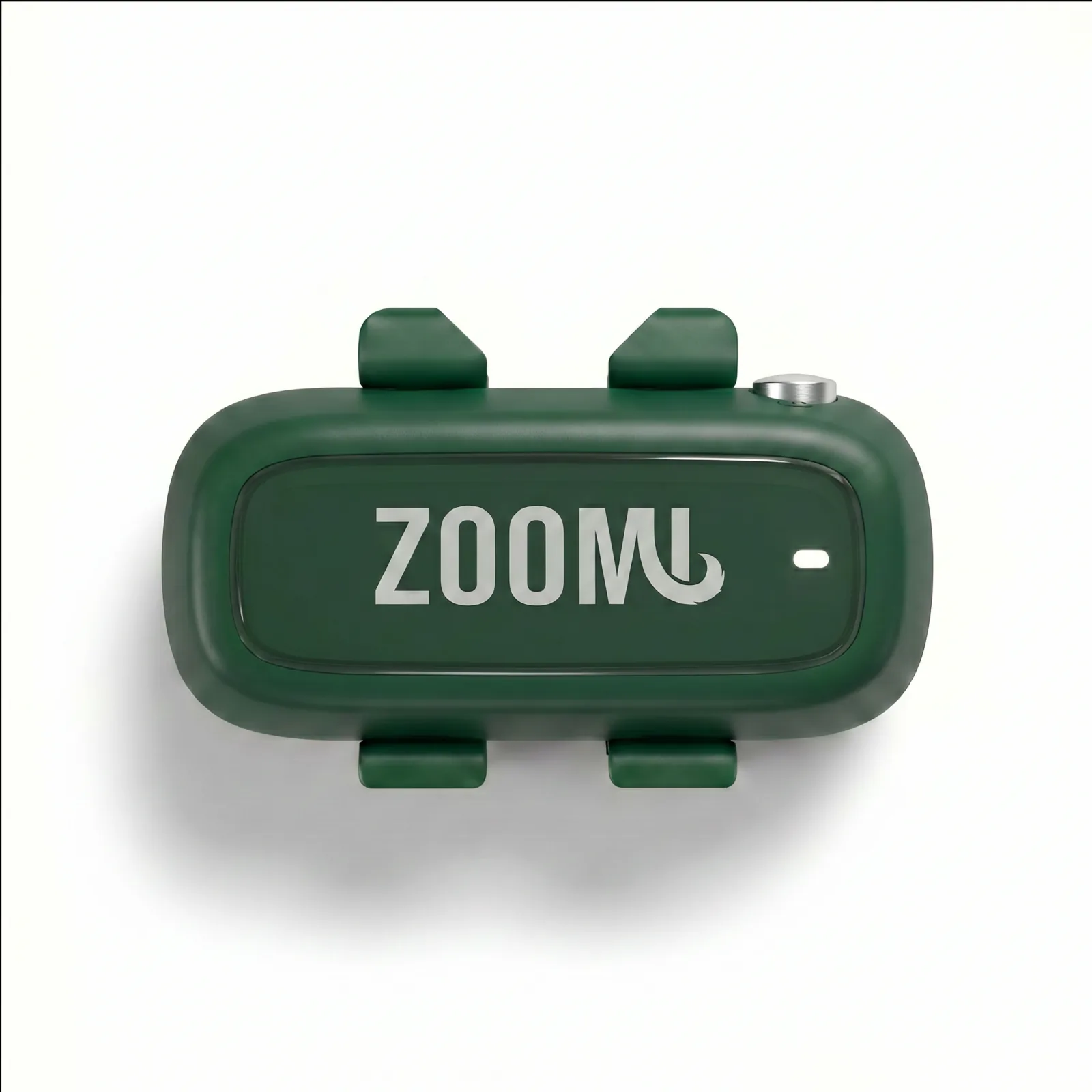
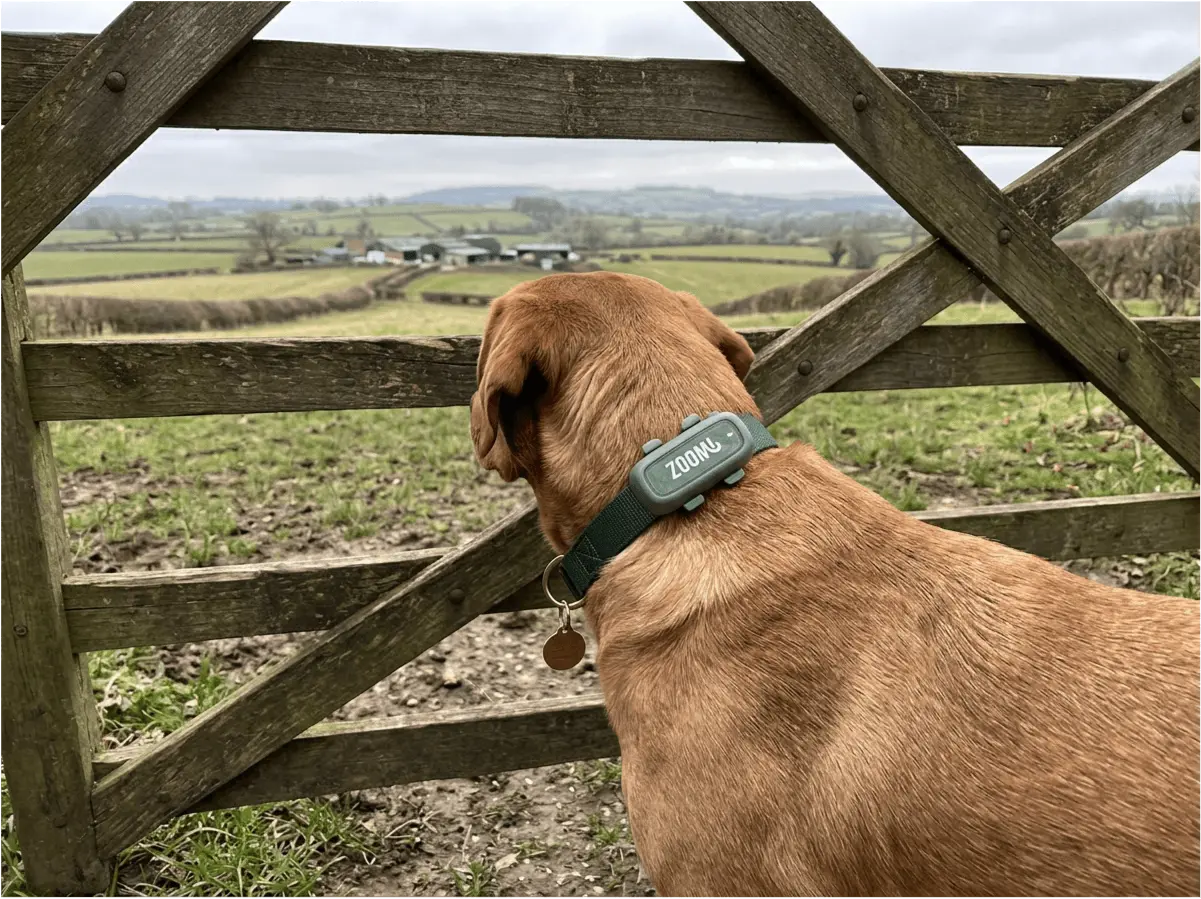
In darkness, the gap between "he was just here" and "he's gone" is seconds. ZoomiTag puts live GPS on the collar — so a dog the night has swallowed is still a moving dot on your phone, with a track you can follow.
See ZoomiTagShifting the Routine (Your Dog Doesn't Read Clocks)
Dogs run on body clocks set by food and walks, and an abrupt one-hour jump registers. The kind fix, recommended by the veterinary charities: move meals and walks by 10–15 minutes a day across this week, so the schedule arrives at the new time smoothly and the 5am breakfast campaign never starts. The strategic fix is better still: move the main exercise walk into daylight where your week allows — before work, at lunch, via a walker or a neighbour swap — and let the dark slot be a shorter, on-lead comfort walk. A dog properly exercised in daylight is also a calmer dog on fireworks evenings, which this season is a double win.
One more routine note for the garden: letting the dog out at 9pm now means letting them into darkness. Fence gaps, gate latches and the fox passing through are all invisible from the kitchen window — worth a torch-lit check of the perimeter this week (our fireworks preparation guide has the full escape audit), and it's exactly what safe-zone alerts exist for: a phone buzz the moment the collar leaves the garden, whether or not you saw it happen.
The Find-Them Layer: When Prevention Loses
Everything above lowers the odds; nothing zeroes them. What changes in the dark is that the traditional response — look where you last saw them, follow, call — barely works. You can't see the direction they went, your torch reaches thirty metres, and a panicked dark-coated dog is functionally invisible until dawn. This is the scenario where live GPS stops being a gadget and becomes the plan: a moving dot, a trail showing which way they went, and a search that follows data instead of guesses. Our guide to GPS dog tags covers how the technology works; virtual fences add the instant escape alert. If your dog wears one, tonight's checklist is one line: on the collar, charged, every evening from now to spring.
The Winter Walk Kit, One Screen
- On the dog: LED collar light (battery checked weekly) · reflective lead or harness · GPS tracker charged
- On you: head torch · something reflective · phone
- This week: meals and walks shifting 10–15 min/day · dark-slot route chosen (lit, pavemented) · garden perimeter checked by torchlight
- Standing rules till spring: short lead near traffic · off-lead only in secure enclosed spaces · main walk in daylight where the week allows
- Fireworks fortnight (now–15 Nov): after-dark walks on-lead, timed before the evening's displays start — the calming guide covers the rest of those evenings
The clocks-change walk has a bad reputation it doesn't deserve. Lit up properly, on a sensible route, with the routine shifted kindly, the winter night walk becomes its own thing — quiet streets, sharp air, a dog delighted by a scent-world you'll never perceive. Equip for it once this week, and you're set until March.
Frequently Asked Questions
Yes, equipped for it — the risk concentrates at roads (drivers can't see dark dogs or dark-dressed owners) and in losing sight of an off-lead dog. Active light on the dog, reflective gear on you both, lit routes, a short lead near traffic and honest off-lead judgement manage all of it. The danger is walking in the dark equipped for daylight.
Yes — an LED collar light is the highest-value item in the winter kit. Reflectives only work when headlights hit them; an LED is visible from every angle all the time. Use both together: LED for constant visibility, reflective gear for the headlight moments at the roadside.
Only in secure, enclosed, familiar spaces, with a light on the collar. Recall weakens in darkness, you can't see what your dog has noticed, and fifteen metres of night swallows a dark dog entirely. During fireworks fortnight the case for the lead is the strongest it gets all year.
Shift meals and walks 10–15 minutes a day across the preceding week, so the body clock arrives smoothly. Better still, move the main walk into daylight — morning, lunchtime, or a walker — and keep the dark slot short and on-lead. Dogs don't read clocks; they read routines.
Better than us in low light, thanks to a reflective layer in the eye — but they judge car speed poorly, scent overrules sight, and their night vision does nothing to make them visible to drivers. That second half — being seen — is the half that kills, and it's entirely the owner's to fix.
Head torch, LED light on the dog, reflective lead or harness, something reflective on you, phone — and for any off-lead time, a charged GPS tracker on the collar, because in the dark your eyes are the first thing to fail and a live map doesn't care whether the sun is up.