Dogs are easy to account for: they're either with you or somewhere they shouldn't be. Cats operate differently. A free-roaming cat lives a second, entirely private life — over the fence, along the hedgerow, through gardens you've never seen and into sheds you didn't know existed. Owners have always accepted "out" as a location, because there was no alternative.
There is now. Yes — you can track your cat's location in real time, watching a live dot move across a map on your phone while it happens. But only one kind of technology can genuinely do this, and it's worth understanding why, because plenty of things sold near the phrase "cat tracker" — microchips, Bluetooth tags, radio fobs — cannot.
This guide covers what real-time tracking actually requires, why cats are the harder engineering problem, what a proper cat tracker can tell you beyond location — and where ZoomiTag for Cats, which fully launches in Q4 this year, fits in.
The Short Answer
To follow a moving animal live, a tracker has to do two things by itself: know where it is (a GPS receiver on the collar, fixing position from satellites) and tell you immediately (a cellular connection sending that position to your phone over the mobile network). Put both in one cat-sized, waterproof device and you get real-time tracking: a position that updates in seconds, anywhere with mobile signal, whether your cat is three gardens over or three streets away at 2am.
Every "tracker" that lacks one of those two ingredients falls short somewhere. A microchip has neither. A Bluetooth tag has neither — it borrows both from strangers' phones. A radio fob knows nothing until you're already nearby sweeping an aerial around like a 1970s TV detective. Only cellular GPS answers the question you're actually asking at the back door: where is she right now?
Why Cats Are Harder to Track Than Dogs
Cat tracking arrived years after dog tracking, and not because nobody wanted it — the engineering is simply harder:
The weight budget is brutal. A Labrador doesn't notice 30 grams on its collar; a 3.5kg cat does. Batteries, GPS antennas, and 4G modems all want space and weight, and shrinking them without gutting battery life is the whole game. It's why so many early "cat trackers" were dog trackers with a smaller strap, and why cats famously refused to wear them.
The collar itself is a safety device. Cats squeeze through gaps, wriggle under fences, and climb through branchwork — so anything around a cat's neck must break away under load. That's the non-negotiable rule (our outdoor cat safety guide covers it in depth), and it means a cat tracker has to assume it will occasionally part company with the cat and be findable afterwards.
Cats roam where phones don't. This is what quietly breaks Bluetooth trackers for cats in particular. A lost dog is usually somewhere people are. A cat's territory is the network of gaps between people — hedges, garages, undergrowth, rooftops. A tag that depends on a passing iPhone can sit metres from your kitchen, silent, for a whole day. (We've written a full breakdown of why AirTags fall short as pet trackers — every word of it applies double to cats.)
Microchipping became compulsory for pet cats in England in June 2024 — and it matters enormously for reuniting found cats with owners. But a chip is identification, not location: a passive capsule with no battery and no signal, readable only by a scanner held centimetres away. It works after someone finds your cat. Real-time tracking is how you do the finding.
Why a Microchip Can't Do This (and What It's Actually For)
The most common misconception in cat ownership: "she's chipped, so I could find her." A microchip is a rice-grain-sized ID tag under the skin. It has no power source and transmits nothing — it simply echoes a registration number when energised by a scanner touching the cat. If your cat is shut in a neighbour's shed, the chip is doing precisely nothing; it becomes useful only at the moment someone else has already found her and carried her to a vet or rescue.
So the chip is essential — it's the law in England, and it's the identification of last resort — but it belongs to a different layer of protection. Think of it as the difference between a passport and a phone: one proves who she is, the other tells you where she is. You want both.
What a Real Cat Tracker Can Do
Once a cat is wearing live GPS, location is just the beginning. These are the capabilities that turn a dot on a map into something closer to a window into that second life:
- Live tracking. Her position on a live map, updating in seconds — not "last seen", but now. When she's late home, you don't wonder; you look.
- Virtual fences and escape alerts. Draw a safe zone — your garden and the two next door, say — and get a notification the moment she crosses out of it. For indoor cats, this is the "she slipped out the window" alarm; for roamers, it's how you learn she's crossed the main road while it's happening.
- Territory history. Replay her routes — today, this week, the whole month. Owners are routinely astonished: the cat who "never leaves the garden" holds a nightly patrol route; the mystery weight gain traces to a second family three doors down with a food bowl.
- Activity and sleep monitoring. The same motion sensing that supports GPS builds a daily picture of movement and rest. Cats are masters at hiding illness — a quiet decline in activity or a shift in sleep is often the earliest sign anything is wrong, visible in data days before it's visible in behaviour.
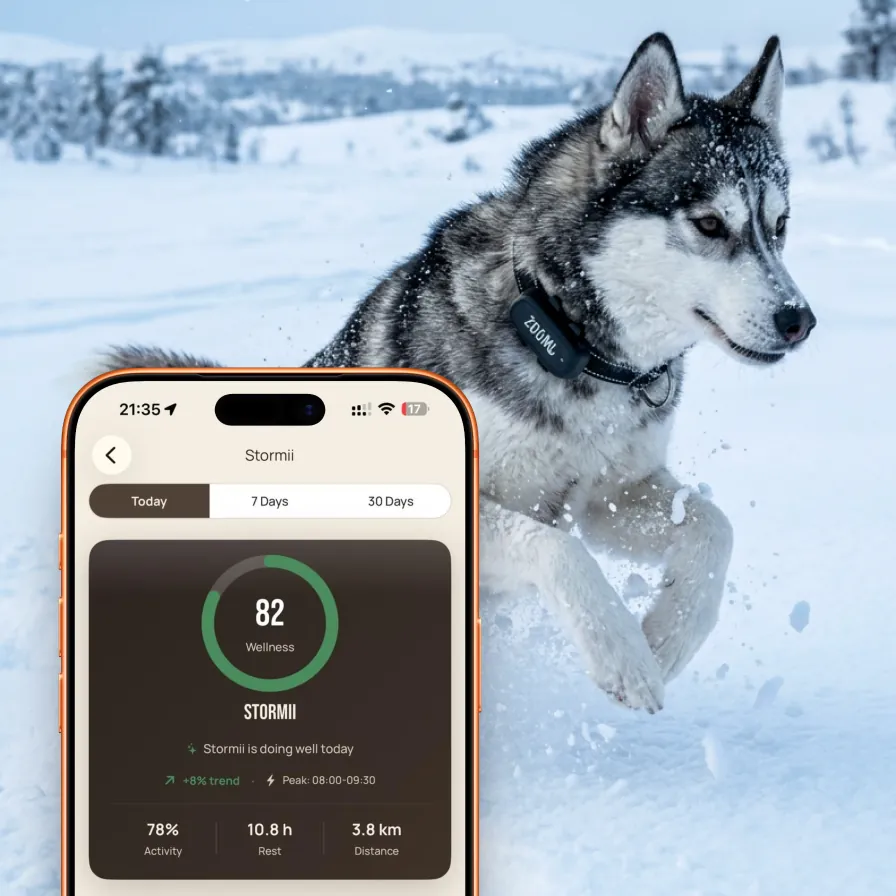
- A wellness score. Activity, rest, and recovery rolled into one daily number, so a slow drift from her normal doesn't slip past you.
ZoomiTag for Cats: Built for the Job — Fully Launching Q4 2026
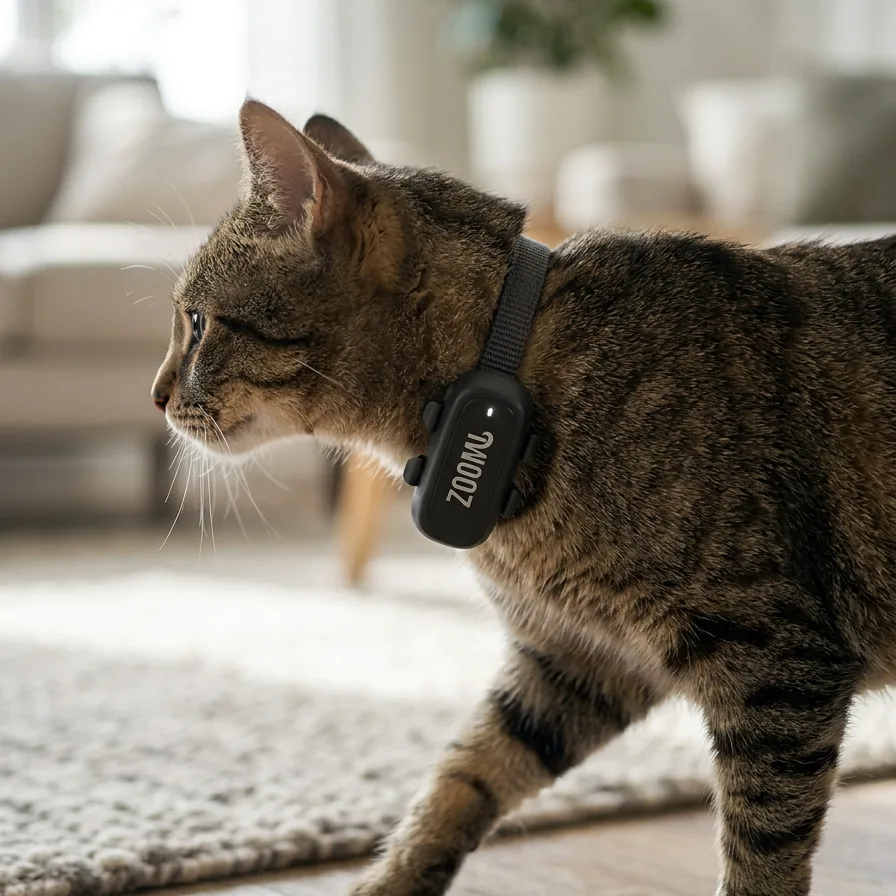
Everything above describes what we've built. ZoomiTag for Cats is the cat-specific version of our ZoomiTag Health tracker — not the dog unit on a thinner strap, but re-engineered around the constraints that make cats hard:
- Genuinely cat-sized. The module weighs around 5 grams and measures 26×18×10mm — light enough that a 3kg cat can ignore it. It fits cats from 3kg to 8kg.
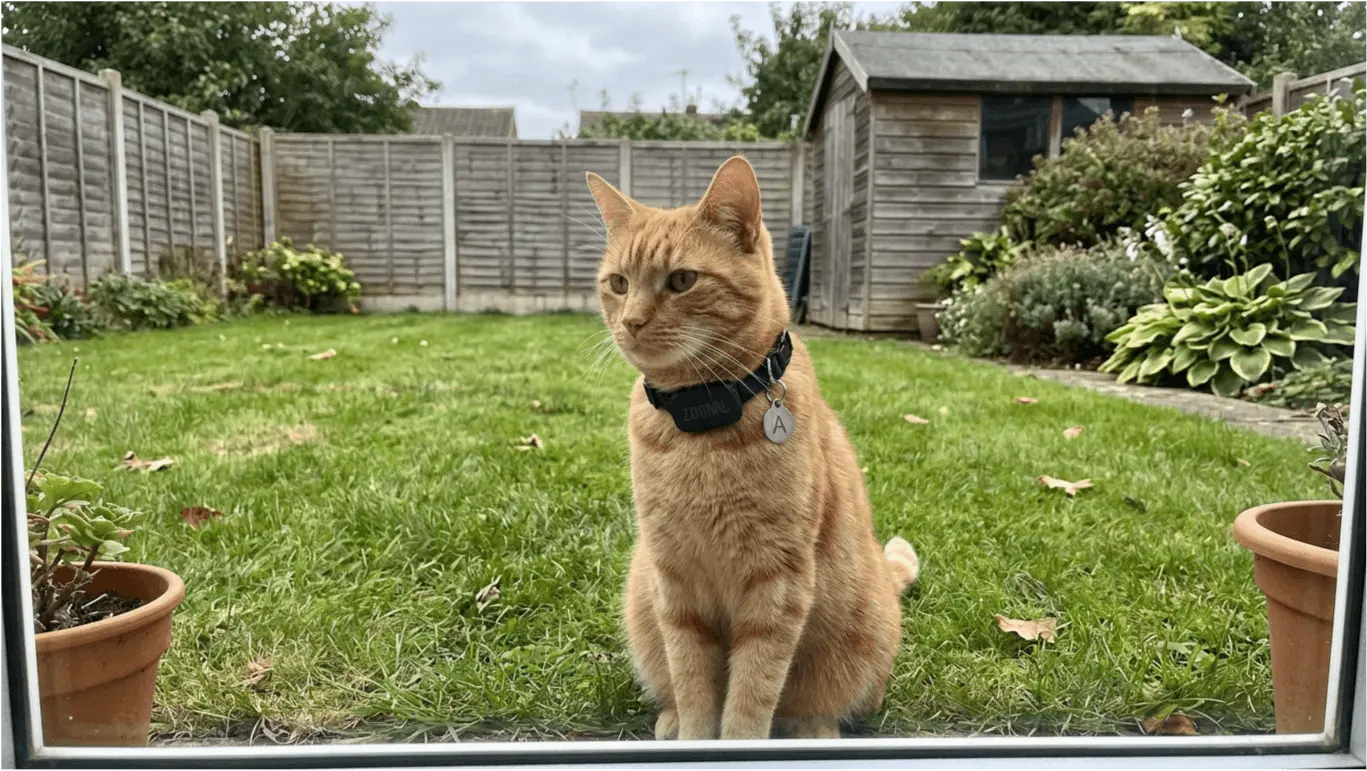
- Safety collar included. A quick-release break-away collar comes in the box, so a snag on a fence releases the collar rather than trapping the cat.
- Real-time 4G GPS. Live location on the map, virtual fences with instant escape alerts, and full location history — working in 175+ countries.
- The health layer. Daily wellness score, activity minutes, and deep/light sleep tracking, with alerts when something drifts from her baseline.
- Built for outdoor life. IP68 waterproof, up to 7 days per charge, and a roughly 60-minute USB-C recharge — one coffee while she sulks indoors.
The honest bit: it isn't on sale quite yet. ZoomiTag for Cats fully launches in Q4 this year — we won't ship it until the cat-specific collar and battery profile are as good as the dog version people already trust. The waitlist is open now: members get the order link before the public store opens, early-access pricing below the public RRP, and first pick of the launch batch. It costs nothing to join and carries no commitment — one email when it's time.
Be First When ZoomiTag for Cats Launches
Real-time GPS, escape alerts, territory history, and health monitoring — re-engineered for cats and fully launching Q4 2026. Waitlist members get early-access pricing and first dibs on the launch batch.
Join the WaitlistWhat to Do in the Meantime
If your cat roams today, the fundamentals still carry most of the load: a registered, up-to-date microchip (check the database after any house move — it's the detail most owners forget), a break-away collar with visible ID, and a realistic picture of the risks around your home. Our complete outdoor cat safety guide walks through all of it, and if the worst happens before the tech arrives, the lost pet recovery guide covers the first hours — which for cats usually means searching close, low, and quiet, because most "lost" cats are hiding within a few houses of home.
And that, really, is the case for real-time tracking in one sentence: cats are rarely far away — they're just invisible. GPS doesn't extend your reach so much as switch the lights on.
Frequently Asked Questions
Yes — with a cellular GPS tracker on a safety collar. It fixes its own position from GPS satellites and sends it to your phone over 4G, so you see a live dot updating in seconds, anywhere with mobile signal. It's the only consumer technology that genuinely does this: microchips have no location capability at all, and Bluetooth tags only report where they were last spotted by a passing phone.
No. A microchip is a passive ID capsule — no battery, no GPS, no signal. It reveals a registration number only when scanned from centimetres away, after someone has already found your cat. It's essential (and compulsory for cats in England, with fines up to £500), but it identifies; it cannot locate.
Not in real time. An AirTag has no GPS chip — its position comes from passing Apple devices spotting its Bluetooth signal, and cats spend their lives exactly where phones don't go: hedgerows, sheds, undergrowth, rooftops. The result is a trail of stale sightings, not a live location. Our full breakdown of AirTags as pet trackers covers the details.
A cat-engineered one, yes. The ZoomiTag for Cats module weighs around 5 grams — light enough for cats from 3kg — and ships on a quick-release break-away collar that releases under load if it snags, which is the golden rule for anything a roaming cat wears. Most cats stop noticing a properly light tracker within a day or two.
Yes. GPS and 4G don't care about darkness — night is when cats are busiest and tracking earns its keep — and ZoomiTag for Cats is IP68 waterproof, so weather isn't a concern. Battery life is up to 7 days per charge, with a full USB-C recharge in about an hour.
ZoomiTag for Cats fully launches in Q4 2026. The waitlist is open now at the product page — members get the order link before the public store opens, early-access pricing below the public RRP, and first pick of the launch batch. Joining is free, spam-free, and commitment-free.