Approximately 74% of UK cat owners allow their cats outdoor access. For most of those owners, the question isn't whether their cat will go outside — it's how to make it safer. Cats that roam freely experience higher levels of stimulation, better mental health, and lower rates of obesity than indoor-only cats. That's genuinely valuable. But outdoor life also exposes cats to a set of real, specific risks that are worth understanding clearly — because most of them can be meaningfully reduced with the right approach.
This guide doesn't argue for keeping cats indoors. It argues for helping outdoor cats come home. The same cat that wanders freely and lives a rich life can also be identifiable, trackable, and recoverable when something goes wrong — and with remarkably simple measures, most owners can have both.
Road traffic is the leading cause of cat mortality in the UK, according to RSPCA estimates. The risk is highest at dawn and dusk, when visibility is lowest and cats are most active. Night-time access is the single factor most strongly associated with road fatality — and the one most easily controlled by the owner.
The Real Risks Outdoor Cats Face
Understanding the actual risk profile of outdoor cat life helps you prioritise what to address. Not all risks are equal — some are common and manageable; others are rare but severe.
Road traffic is the leading cause of death for owned cats in the UK. The highest-risk profile is a young, male, unneutered cat with night-time access near a moderately busy road. Each of those factors individually increases risk; combined, they create a significantly elevated danger profile.
Cat fights are extremely common among outdoor cats, particularly in areas with high cat density. Bites and scratches are painful and prone to abscess; more significantly, fighting is the primary transmission route for Feline Immunodeficiency Virus (FIV) and Feline Leukaemia Virus (FeLV), both incurable and life-limiting. Neutering dramatically reduces fighting behaviour in male cats.
Poisoning is a hidden risk that owners frequently underestimate. Ethylene glycol (antifreeze) is highly toxic to cats and has a sweet taste that attracts them; it remains a significant cause of cat deaths in the UK despite its notoriety. Slug pellets containing metaldehyde, certain rodenticides (particularly second-generation anticoagulants), and toxic garden plants (lilies are severely toxic to cats — even pollen contact can cause kidney failure) all represent real hazards in most suburban environments.
Getting trapped is genuinely common but often not fatal when neighbours are aware. Cats exploring garages, garden sheds, outbuildings, and delivery vehicles can become inadvertently locked in for days. Informing immediate neighbours that you have a cat — and asking them to check before locking outbuildings — prevents many disappearances that get misclassified as straying or theft.
Theft is a growing concern, particularly for certain pedigree breeds. While the overall risk remains low, GPS trackers provide documented movement data that assists with police recovery efforts and insurance claims when theft is suspected.
Essential Safety Gear for Every Outdoor Cat
Not all of the following are legally required, but each one serves a distinct protective function that a single other measure cannot replicate.
1. A quick-release collar
This is non-negotiable for any outdoor cat. A fixed collar — one that doesn't open under pressure — can cause severe injury or strangulation if a cat becomes snagged on a branch, fence post, or other obstacle while exploring. Quick-release (breakaway) collars are designed to open when sufficient force is applied, freeing the cat. They are widely available and there is no legitimate reason to use a fixed collar on an outdoor cat.
The collar should fit snugly enough that you can slip two fingers under it, but no more. Check the fit weekly — cats' weight and coat thickness change with season, and a collar that was fine in summer can become too tight by winter. Elasticated collars alone are not sufficient substitutes for quick-release designs; a limb can become trapped in an elastic loop in a way that won't release.
2. A visible ID tag
Unlike dogs, cats have no legal requirement to wear a collar or tag. But the practical case is identical: a tag is the fastest recovery route. If your cat is found injured by a neighbour, the 60 seconds it takes to read a tag and call you could be the difference between prompt treatment and a worst-case outcome.
Cat tags should be lightweight to avoid irritation and noise. A QR smart tag provides your full contact details, vet information, and medical conditions in a scan — without requiring a bulky engraved surface. Tags should use a lightweight swivel or S-hook attachment, not a heavy split ring that adds unnecessary weight on a small collar.
3. Microchip (now legally required in England)
Since June 2024, all cats in England must be microchipped and registered on an approved database. A microchip alone doesn't help a finder unless they have a scanner — but it provides an independent, permanent identification layer that connects your cat to your details even if they lose their collar. Ensure your chip registration is current. Many cats are microchipped but registered to old phone numbers or addresses — the chip becomes useless unless the database record is maintained.
4. A QR smart tag
A QR smart tag extends what an engraved tag can show exponentially. When a finder scans the code with any smartphone, they see your pet's full digital profile: your name, address, and multiple contact numbers; your vet's details; medical conditions, medications, and allergies; and — if you've activated lost mode — a prominent "this cat is missing" alert that routes all attention to getting in touch with you immediately.
For cats, a smart tag's medical information is particularly valuable. Cats with hyperthyroidism, chronic kidney disease, or FIV/FeLV status need that information communicated to any vet providing emergency treatment. An engraved tag cannot hold this; a smart tag holds all of it indefinitely.
5. A GPS tracker (for high-risk roamers)
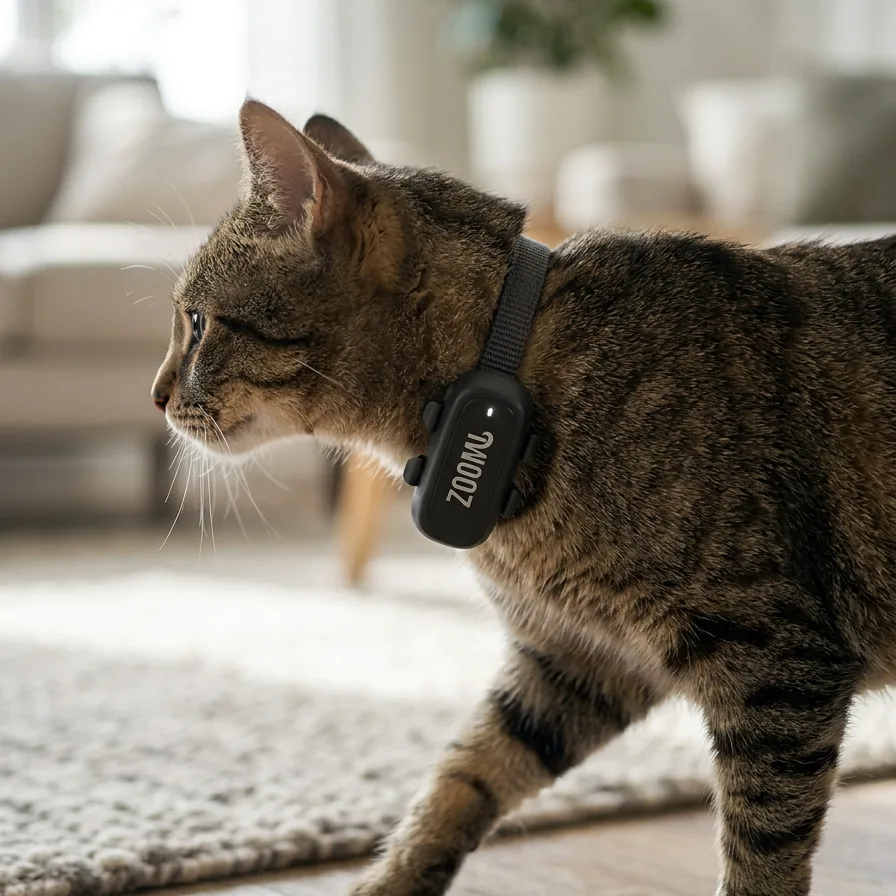
GPS trackers for cats have become significantly lighter and more practical in recent years. For cats near busy roads, in areas with high theft risk, or that have a history of going missing, a GPS tracker provides real-time location data, historical roaming maps, and geofencing alerts when the cat moves beyond a defined boundary. The data also helps you understand your cat's territory — knowing where your cat regularly goes informs your risk assessment and where to search if they go missing.
UK Microchipping Law: What You Need to Know in 2026
England's cat microchipping law came into force in June 2024. The key points:
- All cats must be microchipped and registered on an approved database before 20 weeks of age.
- Cats already over 20 weeks when the law came into force were required to be chipped immediately.
- Non-compliance results in a notice requiring microchipping within 21 days, followed by a fine of up to £500 for continued non-compliance.
- The chip must be registered on an approved database (Petlog, PetDatabase, Identibase, or others on the government-approved list).
- Keeping registration details current is your responsibility. Moving house or changing phone number without updating the database defeats the purpose of the chip.
Scotland and Wales have similar legislation progressing through their respective parliaments. If you have a cat in those nations, it is worth checking the current status as this may have updated since publication.
Creating a Safer Roaming Environment
You cannot entirely remove outdoor risk, but you can shape the environment to reduce it. These steps, taken together, meaningfully lower the probability of serious incidents:
- Map your cat's territory before making assumptions about their risk. Cats don't roam uniformly — they have preferred areas, regular routes, and specific locations they visit consistently. A GPS tracker worn over two to three weeks will reveal your cat's actual range and whether they're regularly approaching roads, neighbouring properties with dogs, or other hazard areas. This data-informed picture is far more useful than guessing.
- Inform your immediate neighbours that you have an outdoor cat. Ask them to check before locking garages, sheds, greenhouses, and outbuildings. A two-minute conversation prevents many multi-day disappearances. Provide your phone number so they can contact you if they spot your cat somewhere unusual. This is the simplest, most cost-free safety measure available.
- Remove or fence off toxic plants in your garden. Lilies (all species, including peace lily and calla lily) are severely toxic to cats — pollen contact alone can cause acute kidney failure. Other common hazardous plants include foxglove, rhododendron, yew, and oleander. The ASPCA maintains a comprehensive toxic plant database. Replace or fence off hazardous plants if your cat regularly accesses your garden.
- Consider cat-proof fencing for high-risk cats. Roller-top systems (cylindrical rollers mounted on fence tops that spin under a cat's paws) and inward-angled fence extensions prevent most cats from leaving the garden. They're a meaningful investment but provide a contained outdoor space for cats near very busy roads or in areas with known predator activity. Cat enclosures and "catios" offer a similar benefit.
- Install a microchip cat flap with a curfew setting. Modern cat flaps can be programmed to lock at set times — keeping your cat in during the highest-risk periods (dusk to dawn) without requiring you to actively supervise their access. The microchip reader ensures only your cat can use it, solving the problem of neighbourhood cats entering your home.
- Store antifreeze, slug pellets, and rodenticides in sealed containers, away from cat access. Do not use metaldehyde slug pellets (now banned for professional use but old stock persists) in any garden where cats roam. Opt for iron-based alternatives. Be aware of what neighbours use — antifreeze spills in shared driveways and car parks are an ongoing risk.
Time of Day and Seasonal Risk
Not all outdoor time carries equal risk. Understanding when risk is highest allows you to make targeted adjustments rather than restricting your cat's freedom across the board.
Dawn and dusk are peak risk times for road accidents. Light levels are lowest, contrast is poor, and cats are naturally most active during these crepuscular periods — the combination is directly reflected in accident statistics. Keeping your cat in during the hour before and after sunrise and sunset addresses the highest-risk window.
Night-time (post-dusk to pre-dawn) carries three times the road accident risk of daytime in UK studies. Fighting and predator encounters are also more common. The RSPCA's position is that keeping cats indoors from dusk to dawn is the single most effective safety measure. It does not eliminate risk, but it removes the highest-risk exposure.
Winter months increase risk due to shorter daylight hours (pushing active hours into darkness), icy roads (where drivers have less control), and cats seeking warmth in dangerous places — under car bonnets and inside wheel arches. Check under the bonnet of any car that has been parked overnight if there are outdoor cats in your area.
Summer and fireworks season (late October, Bonfire Night, New Year) are times when cats are more likely to bolt and become lost. Frightened cats often travel further than their normal range and take shelter in unfamiliar places. Keeping cats in during expected fireworks events is strongly recommended.
How to Monitor an Outdoor Cat's Patterns and Wellbeing
Free-roaming cats are, by definition, harder to monitor than dogs on walks. But passive monitoring — using their patterns as a health signal — is possible with the right tools.
GPS location tracking provides the most direct monitoring: you can see where your cat is in real time, receive alerts if they leave their normal range, and review historical movement data to detect changes. A cat that normally covers 300m of territory and has recently been staying within 50m of home may be injured, unwell, or in fear. A deviation from normal range is a meaningful data signal.
Activity levels over time reflect health and wellbeing. A gradual reduction in movement — shorter outings, less exploration — can be an early indicator of joint pain, illness, or advancing age. ZoomiTag's activity tracking logs your cat's daily movement patterns, building a baseline that makes changes visible before they become obvious.
Geofencing alerts notify you when your cat crosses a defined boundary — either getting too close to a road, leaving your property, or entering an area of concern. These are particularly useful for new cats learning their territory, elderly cats with reduced spatial awareness, or any cat that has had a previous accident or escape.
Morning and evening check-ins — even if only visual — establish a rhythm that helps you notice when something has changed. A cat that normally greets you at feeding time and is absent for two consecutive mealtimes deserves investigation, not assumptions that they're simply elsewhere. Most prolonged disappearances begin with a period of "they're probably just out" that turns out to be hours or days of the cat being trapped, injured, or lost.
Know Where Your Cat Is — and When They Left Their Normal Range
ZoomiTag gives your cat a digital identity anyone can scan plus geofencing alerts when they go somewhere unexpected. No ongoing monitoring needed — it runs quietly in the background and tells you when it matters.
See ZoomiTag for CatsIf Your Cat Goes Missing
Even with every precaution in place, cats go missing. Most missing cats are found within 200m of home — typically trapped, hiding, or injured. The first 24–48 hours are the most important, and the steps taken in that window determine the likelihood of recovery.
Check every outbuilding, garage, shed, and enclosed space within a 100m radius before assuming your cat has gone far. Cats that are frightened or injured often hide very close to home and are silent even when you call. Search at night with a torch — your cat is more likely to be awake and responsive. Take a familiar-smelling item (a worn jumper) to areas you search.
Register the loss on DogLost (which covers cats as well as dogs), post on local Facebook groups, and notify all vets within a 2km radius with a photograph. A missing-pet profile with a photo — available to anyone who scans your cat's QR tag — is something that finders can screenshot and share on social media in seconds, without needing to write down any details.
Frequently Asked Questions
Night-time is significantly more dangerous for outdoor cats. UK data suggests cats are around three times more likely to be involved in a road accident at night due to reduced visibility and higher traffic speeds. Predator encounters and cat fights are also more common after dark. The RSPCA recommends keeping cats indoors from dusk to dawn as the single most effective safety measure for outdoor cats — without eliminating daytime outdoor access.
Not inherently — millions of indoor cats live full, healthy, and contented lives, particularly when given adequate environmental enrichment (vertical space, regular interactive play, puzzle feeders). A cat that has previously had outdoor access may find sudden restriction stressful, and gradual transitions work better than abrupt changes. Many vets in high-traffic urban areas now recommend indoor-only living for cats near busy roads as the safest option.
It varies considerably. Neutered males and females typically roam within 40–100 metres of home. Unneutered toms can range several kilometres. Individual temperament plays a large role — some confident, explorative cats will claim a much wider territory than more timid housemates. GPS tracking studies have found that the range of a single cat can vary dramatically from day to day depending on weather, season, and whether they encounter other cats in their territory.
Yes, in England since June 2024. All cats must be microchipped and registered on an approved database. Failure to comply can result in a £500 fine. The chip must be kept up to date — a chip registered to an old phone number or address is effectively useless. Scotland and Wales have similar legislation progressing. All UK cat owners should ensure their cats are chipped and that their registration details are current.
Any collar worn by an outdoor cat must be a quick-release (breakaway) design — one that opens under pressure if the collar catches on an obstacle. Fixed collars pose a genuine strangulation risk for cats. Elasticated collars are not a safe substitute. The collar should fit so you can slip two fingers underneath it. Check weekly for changes in fit. A lightweight ID tag or QR smart tag should be attached with a lightweight swivel fitting, not a heavy split ring.
Complete prevention is difficult without physical barriers. Cat-proof fencing with roller tops or inward-angled extensions contains most cats to a garden. A microchip cat flap with a curfew mode keeps cats in during high-risk periods without requiring active supervision. Keeping your cat in at night is the most effective single intervention for road safety. GPS geofencing alerts can notify you when your cat approaches a road boundary you've set — allowing you to intervene before an accident.