Ask "how do I track my dog?" in any owners' group and the first reply is usually the same: AirTag. £29. Done. It's an understandable instinct — AirTags are genuinely brilliant at what they were built for, and clipping one to a collar feels like solving pet tracking for the price of a bag of decent dog food.
The short answer: you can put an AirTag on your dog, but it will not track your dog — not in the way you're imagining when you picture following a moving dot across a map. The difference isn't a software limitation Apple might patch; it's the fundamental design of the device. Apple itself has said plainly that AirTag was designed to track items, not pets or people.
This guide explains how AirTag actually works, where that breaks down for a dog, the safety problems that rarely make it into the group-chat recommendation, the situations where an AirTag genuinely earns its keep — and what a purpose-built GPS tracker does differently. (For the side-by-side spec table, see our ZoomiTag vs AirTag comparison.)
An AirTag cannot determine its own location. It has no GPS receiver and no mobile connection — it's a Bluetooth beacon with a battery. Every location you've ever seen for an AirTag was actually reported by someone else's iPhone, iPad, or Mac that happened to pass within Bluetooth range. That borrowed-eyes model is the key to everything AirTag does well, and everything it can't do for a dog.
How an AirTag Actually Works
An AirTag broadcasts a rotating, anonymous Bluetooth signal. Any nearby Apple device on the Find My network — and there are hundreds of millions of them — quietly hears that signal, notes its own location, and relays it to Apple, encrypted, so the owner sees the tag on a map. Nobody in the chain knows they helped; it's elegant, private, and effectively free to run, which is why there's no subscription.
Up close, newer iPhones add Precision Finding: ultra-wideband radio that points you toward the tag with an arrow and a distance readout, accurate to less than a metre. And if you're within Bluetooth range, you can make the AirTag play a sound.
Notice what every one of those features has in common: they locate a stationary object after the fact. Keys stay where you dropped them. A wallet waits patiently under the sofa cushion. The entire system is built around the assumption that the lost thing isn't going anywhere — which is precisely the assumption a lost dog violates.
Where That Breaks Down for a Moving Dog
The location is a history, not a live feed. The map shows where your dog's AirTag was last seen by a passing device. If your spaniel bolted through the hedge ten minutes ago and hasn't crossed paths with an iPhone since, you're staring at a pin in your own garden. A dog at full run covers a lot of ground between sightings — by the time a jogger's phone logs the tag on the far side of the park, the dog may already be two fields further on. You're not tracking; you're archaeology.
Coverage is other people. AirTag works best exactly where dogs are least likely to get lost: dense, iPhone-rich streets. The moment your dog disappears into woodland, farmland, a beach in winter, or anywhere at 2am, the network of borrowed eyes thins to nothing. Rural Britain is the worst case — a dog can be missing overnight within a mile of home and never come within Bluetooth range of a single device.
No alerts when it matters. An AirTag cannot tell you your dog has left the garden. Apple's "Notify When Left Behind" feature is built for the opposite problem — you walking away from your keys — not for an animal leaving a safe area while you're at work. By the time you know there's a problem, the escape is old news. (This is exactly the job geofence alerts exist for: a virtual fence around the garden, and a notification the moment the collar crosses it.)
The anti-stalking system works against you. Because AirTags were misused for tracking people, Apple and Google both ship unknown-tracker alerts. If your dog spends the day with a walker, a sitter, or — in the worst case — whoever picked them up, that person's phone can flag the AirTag as suspicious, show them how to find it, and walk them through disabling it. The tag can also start playing sounds once it's been away from you for a while. For pet tracking, the safety system designed to protect people actively undermines the one job you bought it for.
The Safety Problems Nobody Mentions
Three practical issues come up repeatedly with AirTags on dogs, and they're worth taking seriously:
- The button battery. An AirTag runs on a CR2032 coin cell behind a twist-off cover. Dogs chew tags — it's what they do — and a swallowed button battery is a genuine veterinary emergency, capable of causing severe internal burns within hours. If an AirTag ever goes on your dog, it belongs inside a sealed, chew-resistant holder, checked regularly.
- The speaker. An AirTag away from its owner plays sounds by design. A noise-phobic dog wearing a periodically chirping collar is not a calmer dog — and the chirp also announces the tag's presence (and location) to anyone nearby.
- The attachment. AirTag has no collar mount of its own; everything depends on a third-party holder. Collars get soaked, scratched, rolled on, and yanked through undergrowth — conditions no keyring accessory was engineered for. Lost-AirTag-holder stories are their own genre in pet forums.
What an AirTag Can't Do at All
Beyond location, an AirTag knows nothing about the animal wearing it. There's no profile — a finder who taps it with their phone sees a phone number at most, with no name, photo, temperament notes, or medical information for the frightened dog in front of them. There's no health layer — no activity, sleep, or wellness data, so nothing to flag the subtle slowdown that precedes illness (our guide to the pain signs owners miss shows why that data matters). And it doesn't touch your legal obligations: under the Control of Dogs Order 1992, a dog in public still needs a collar with your name and address on it — an AirTag doesn't count, as our dog tag ID guide explains.
Where an AirTag Is Genuinely Fine
Credit where it's due. If you live in a dense town or city, an AirTag is a reasonable backup layer: cheap, light, no subscription, and a battery that lasts about a year. For a strictly-on-lead urban dog whose worst-case scenario is slipping the lead on a busy street, the Find My network will probably produce a sighting within minutes. Plenty of ZoomiTag owners run an AirTag as a second string, and that's a perfectly rational setup — redundancy is never wasted on something you love.
The mistake isn't owning an AirTag. The mistake is believing it's a dog tracker — and discovering the difference at the worst possible moment, in a dark field, staring at a pin that says your dog is somewhere they left an hour ago.
Most escapes happen close to home and end well — but the recoveries that go fastest belong to owners who can see where the animal actually is, rather than where it was last spotted. When the worst happens, minutes matter: our lost pet recovery guide covers the first-hour playbook, and it's a very different playbook when you're walking toward a live dot instead of canvassing a neighbourhood.
What a Dedicated GPS Tracker Does Differently
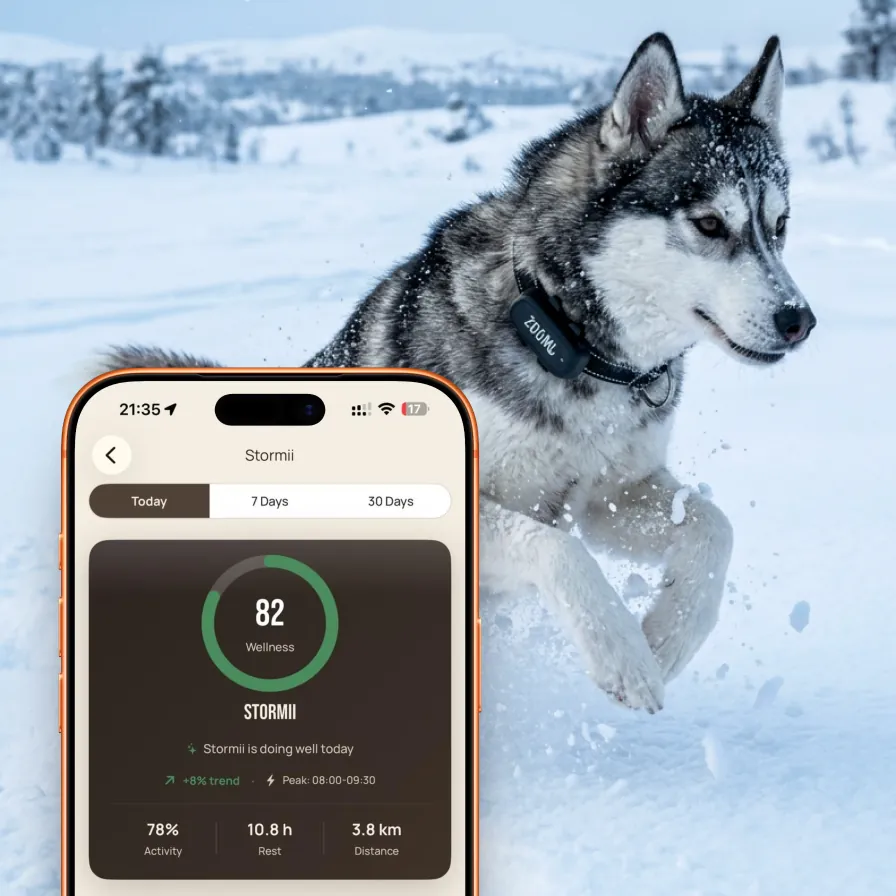
A cellular GPS tracker — ZoomiTag Health is ours — inverts the AirTag model. Instead of waiting to be noticed, the tracker carries its own GPS receiver and 4G modem and reports its own position, continuously, from anywhere with mobile signal. That one architectural difference is what buys you:
- A live map. The dot is your dog, now — updating in seconds while you walk toward them, not a stale sighting from whenever an iPhone last wandered past.
- Virtual fences. Draw a safe zone around the garden, the sitter's house, the holiday cottage; get an alert the moment the collar crosses the line — usually while the dog is still in sight of home.
- Route history. Replay where they've been — useful for lost-dog forensics, and quietly fascinating the rest of the time.
- The health layer. Activity minutes, sleep quality, and a daily wellness score from the same device — the early-warning data an item tracker can't gather.
- A finder-friendly tag. Anyone who finds your dog scans the tag (NFC or QR, no app needed) and sees their name, photo, medical notes, and every way to reach you.
The honest trade-offs: a GPS tracker needs charging every week or two rather than yearly, and the cellular connection means a subscription (£49/year for ZoomiTag). That's the cost of a device that phones home by itself. Whether that's worth it depends on one question: if your dog went through the hedge right now, would you rather have a live position — or a £29 note that they were in the garden ten minutes ago? Our smart tags vs GPS trackers guide digs into the full cost-over-three-years maths.
Built to Track Dogs, Not Keys
ZoomiTag Health gives you live GPS on a moving dog, virtual fence alerts the moment they leave a safe zone, health monitoring, and a scannable profile for whoever finds them first.
See the Full AirTag ComparisonThe Verdict
Use an AirTag for the things it was designed for — and it was not designed for your dog. As a cheap urban backup on a well-secured, sealed holder, it's a sensible extra layer. As your only answer to "what happens if she runs?", it's a coin toss that depends on strangers' phones being in the right field at the right moment. A dog that can bolt deserves a tracker that answers the only question that matters in that moment — where are they right now? — and only a live GPS tracker can answer it.
Frequently Asked Questions
Physically yes, via a third-party holder — AirTag has no attachment point of its own. But Apple has been clear AirTag was designed for items, not pets: on a collar it gives you no live location, no safe-zone alerts, and updates only when the dog passes another Apple device. Fine as a cheap backup layer; not a dog tracker.
No. There's no GPS chip in an AirTag — it's a Bluetooth beacon located by passing Apple devices. Between sightings the map shows the last known position, which for a moving dog can be minutes or hours stale. Real-time tracking needs a device with its own GPS receiver and cellular connection.
Three cautions: the CR2032 button battery is dangerous if a chewing dog gets the tag open and swallows it (an emergency vet situation); the built-in speaker plays sounds when the tag is away from you, which can spook noise-sensitive dogs; and third-party collar holders vary wildly in how well they survive real dog life. If you use one, choose a sealed, chew-resistant holder and check it regularly.
Poorly — coverage is entirely dependent on passing Apple devices. City streets can produce updates every few minutes; woodland, farmland, and quiet villages at night can produce nothing for hours, which is exactly where and when dogs go missing. A cellular GPS tracker reports its own position over the mobile network instead.
An AirTag is a passive Bluetooth beacon that other people's devices occasionally spot; a GPS tracker actively reports its own position over 4G. That's what enables a live map, geofence alerts, route history, and — on ZoomiTag Health — activity, sleep, and wellness monitoring plus a scannable finder profile. The trade-off is weekly-ish charging and a subscription for the cellular connection.
No. The Control of Dogs Order 1992 requires a dog in public to wear a collar showing the owner's name and address — visible, readable ID. An AirTag shows nothing to the naked eye, so it doesn't meet the requirement (nor does a microchip alone). Whatever tracker you use, keep legal ID on the collar too.